
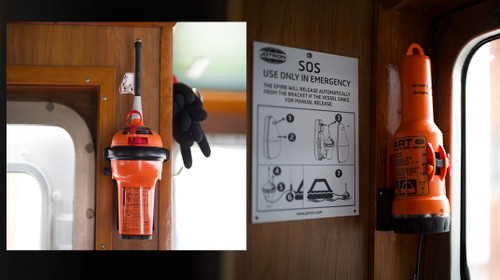
EPIRB vs SART: What’s the Difference?
When it comes to marine safety, both the EPIRB (Emergency Position Indicating Radio Beacon) and the SART (Search and Rescue Transponder) are life-saving devices.
They may seem similar, but they serve different purposes and work in different ways during a rescue.
Let’s break it down simply.
What is an EPIRB?
An EPIRB (Emergency Position Indicating Radio Beacon) is your first alert signal in an emergency.
When your boat is sinking or in danger, the EPIRB sends a distress signal via satellite to rescue authorities. It shares your location, helping rescuers start the search and rescue mission immediately.
-
Purpose: Alerts search and rescue services that you’re in distress.
-
Activation: Can be manual or automatic (activates when it touches water).
-
Signal: Transmits on 406 MHz, which is detected by Cospas-Sarsat satellites around the world.
-
Coverage: Works globally, so you can be found anywhere at sea.
Modern EPIRBs also include:
-
GPS/GNSS for precise location
-
AIS-homing signal to help nearby vessels find you
-
121.5 MHz homing beacon for short-range rescue
-
LED lights for visibility
-
Return Link Service (RLS) to confirm that your distress signal was received
✅ In short: The EPIRB is your first call for help, alerting satellites and authorities the moment an emergency occurs.
What is a SART?
A SART (Search and Rescue Transponder) helps rescuers locate you precisely once they are near your area.
While an EPIRB calls for help globally, the SART gives exact positioning when rescue vessels or aircraft are close.
There are two main types of SARTs:
1. Radar SART
-
Signal: Responds to 9 GHz (X-band radar) signals.
-
Use: Helps rescuers using radar find your exact location.
-
Range: Works within 8–10 nautical miles (can reach up to 30 miles from the air).
-
Activation: Manual — turned on by the user.
2. AIS SART
-
Signal: Sends your position through the AIS (Automatic Identification System) channels.
-
GPS Enabled: Uses GNSS/GPS to pinpoint your coordinates.
-
Use: Displays your position directly on rescuers’ navigation screens.
✅ In short: The SART helps rescuers see you on their radar or AIS display, guiding them to your exact spot.
EPIRB vs SART — Key Differences
| Feature | EPIRB | SART |
|---|---|---|
| Full Name | Emergency Position Indicating Radio Beacon | Search and Rescue Transponder |
| Main Purpose | Sends a global distress alert via satellite | Helps rescuers find you locally |
| Signal Frequency | 406 MHz (satellite) + 121.5 MHz (homing) | 9 GHz (Radar SART) / AIS.1 & AIS.2 (AIS SART) |
| Coverage | Worldwide (via Cospas-Sarsat satellites) | Short range (8–10 nm, up to 30 nm from aircraft) |
| Activation | Automatic or manual | Manual |
| Use Stage | Initial distress alert | Final locating during rescue |
| GPS/GNSS | Yes | Yes |
| RLS (Return Link Service) | Yes (on latest models) | No |
| Lights/Visual Indicators | Yes (LED, infrared) | Limited |
| Requirement | Mandatory for most vessels | Recommended or required depending on vessel type |
Think of it like this:
-
The EPIRB tells the world you need help and where you are generally.
-
The SART helps rescuers find your exact position once they arrive in your area.
Both are part of the Global Maritime Distress and Safety System (GMDSS) — ensuring you’re never truly alone in an emergency.
Regulations and Requirements
EPIRB Regulations
-
Required under IMO and SOLAS for vessels in international waters.
-
Must be registered and programmed with your vessel’s unique ID (IMO number or MMSI).
-
Considered a primary alert device by maritime authorities.
SART Regulations
-
Governed by the same IMO, SOLAS, and GMDSS standards.
-
Seen as a secondary alert device — not mandatory for all boats, but strongly recommended.
Facts to Remember
-
An EPIRB sends a satellite distress alert, starting the search and rescue.
-
A SART provides local tracking, helping rescuers home in on your exact location.
-
Both are essential safety tools — together, they give you the best chance of being found quickly.
Final Summary
| Device | Main Role | Coverage | Activation | Who Detects It |
|---|---|---|---|---|
| EPIRB | Global distress alert | Worldwide | Auto / Manual | Satellites & Rescue Centers |
| Radar SART | Radar-based location | 8–10 nm | Manual | Rescue Vessels / Aircraft |
| AIS SART | AIS-based location | 8–10 nm | Manual | Ships with AIS Systems |
✅ EPIRB = Global Alert
✅ SART = Local Locator
Together, they make sure your distress call is heard — and you’re found fast.